
Quick answer
Eight cards do most of the frightening in a tarot deck: Death, the Tower, the Devil, the Ten of Swords, the Three of Swords, the Five of Pentacles, the Nine of Swords and the Hanged Man. The old version of this page told readers these cards show what is coming. Tarot does not predict; controlled tests come out at chance, and a card that foretold a bad week is the week being remembered through the card. What the cards do well is name a hard situation without softening it, which makes them the most useful cards in the deck for reflection. Death is an ending already underway; the Tower is a structure that was going to fall; the Devil is a habit you keep choosing. Read as prompts, each asks a question you may have been avoiding. Read as forecasts, they only add dread. The daily-pull method, with thirteen starter spreads and a journal, is in A Daily Tarot Pull: How to Do It, What It Actually Does, Thirteen Starter Spreads, and a Journal That Shows What Helps.
Each card, what people fear, the traditional meaning, and a prompt
| Card | What people fear | Traditional meaning | Prompt |
|---|---|---|---|
| Death (XIII) | A literal death | Ending, transition, the close of a chapter already closing | What is over that I am still tending? |
| The Tower (XVI) | Disaster out of nowhere | Sudden collapse of something built on a weak foundation; shock, then clarity | What have I known was unstable, and what would I build instead? |
| The Devil (XV) | Evil, possession | Bondage by choice: a habit, contract, relationship or belief you could leave and do not | What am I chained to that I hold the key for? |
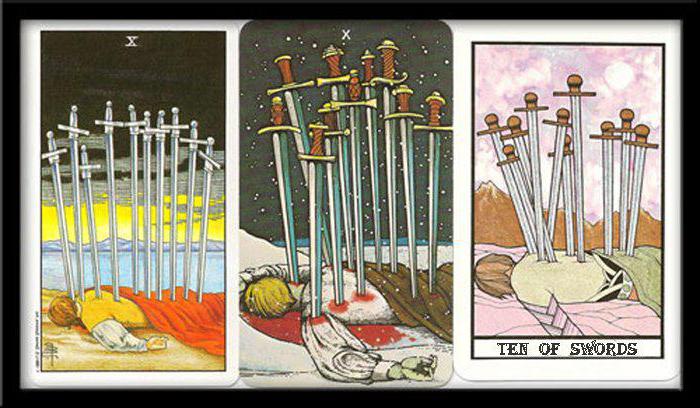
| Ten of Swords | Betrayal, ruin | The lowest point, a defeat that is complete and therefore finished; dawn in the background | What is finished, and what does the morning after look like? |
| Three of Swords | Heartbreak | Grief; the pain of a truth said aloud; sorrow that is clear rather than confused | What have I been told, or need to say, that hurts because it is true? |
| Five of Pentacles | Poverty, illness | Hardship and feeling shut out, with help close by and not asked for | Whose door am I walking past? |
| Nine of Swords | Dread, nightmares | Anxiety in the night; worries larger than the day makes them | Which of these worries survives being written down in the morning? |
| The Hanged Man (XII) | Punishment, being stuck | Suspension by choice, a pause, seeing from a new angle; not a defeat | What would I see if I stopped pushing for a week? |
If a frightening card comes up
- Say the traditional meaning out loud, not the fear
- Write the prompt and answer it in three lines
- Check whether the question was already on your mind, which is usually why the card stings
- Never make a medical, legal or financial decision on a card
- If the card matches a real danger in your life, act on the danger, not the card
What the old version got wrong: It said the Five of Pentacles means you are going to go through poverty or an illness and the Three of Swords means pain is coming. Cards cannot know that. If a reader says a card shows illness, a curse, or a block that money can lift, end the reading, and if money changed hands, report it to the Canadian Anti-Fraud Centre. For the warning signs in full, see tarot reader scam warning signs; for the cards as a skills drill, see tarot as an intuition drill.
The full guide to a daily tarot pull
The hub explains how to do a daily pull, what it actually does, thirteen starter spreads, and a journal that shows what helps.
It’s interesting how the article demystifies some of the more ominous cards like the Death and Devil cards. The emphasis on interpretation rather than fear is a crucial takeaway.
The article provides a balanced perspective on tarot readings, emphasizing the importance of preparedness. It’s clear that the cards serve as a guide rather than a definitive prediction.
The piece does a good job explaining the potential for negative readings without being alarmist. It’s a reminder that not all insights will be pleasant, but they can still be useful.
I appreciate the practical advice on how to handle negative tarot readings. The focus on preparation and coping strategies is particularly helpful.
This article gives a realistic overview of the challenges in tarot readings. It’s a sobering reminder that not all predictions are favorable, but understanding them can be beneficial.