


If you believe in reincarnation, past-life regression may appeal as a way to explore a story, image or feeling that seems connected with another lifetime. You can approach that interest with curiosity while remaining careful about what a session can establish.
An experience may feel meaningful without becoming a verified historical record. Keeping that distinction does not require dismissing your beliefs; it helps you decide how much weight to give an interpretation.
What might happen in a session?
Practices vary. A practitioner may use relaxation, guided imagery or hypnotic suggestions and invite you to describe what comes to mind. Some people report pictures or sensations; others notice very little. There is no experience you must produce to be a successful participant.
Ask for a plain-language explanation beforehand. You should know the session length, fee, cancellation terms, whether it is recorded and how to stop. You can decline a prompt, keep an experience private or end the appointment.
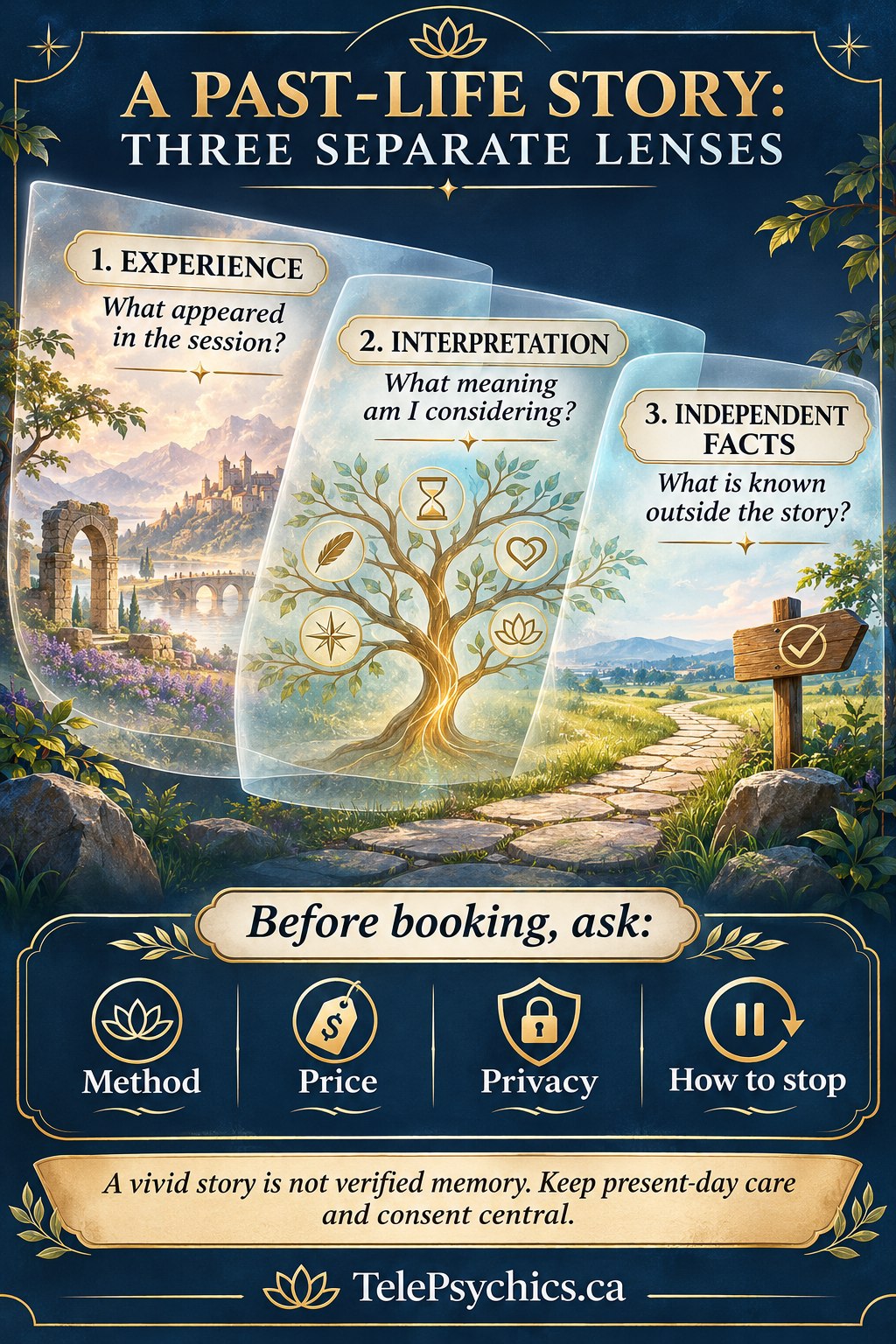
Hold the story lightly
Try recording three separate things: what you experienced, what you think it might mean, and what—if anything—is independently known. Keeping those columns separate prevents a compelling interpretation from quietly becoming an established fact.
A reflective question
“What does this theme bring to mind in my present life?” leaves room for useful reflection. “Who must repay me for what happened in that lifetime?” assigns an obligation that the experience cannot establish.
Six reasons people seek a past-life reading
People sometimes describe these as benefits, but they are possible aims for reflection rather than promised outcomes. A session may not provide relief or clarity, and you can explore these questions without purchasing one.
1. A different perspective
A symbolic story may help you name a present concern. Ask what the theme means today rather than assuming it describes a documented earlier life.
2. Attention to a current problem
A scene may suggest a question about work, habits or relationships. Use current evidence to understand the problem; imagery does not identify the cause of an illness or injury.
3. A moment of mindful noticing
You can notice feelings, thoughts and surroundings without needing to produce a dramatic memory. The exercise may feel engaging, neutral or uncomfortable.
4. Compassion for yourself and others
A story about vulnerability may invite kindness. Nobody needs a past-life explanation to deserve compassion, and suffering is not proof of karmic punishment.
5. Questions about purpose
Ask which values, interests or strengths you want to express now. A reader cannot assign a fixed destiny or establish that a particular career is your soul’s obligation.
6. An intention to loosen an attachment
You might decide to put away a reminder, set a boundary or seek support. A reading cannot require forgiveness, reunion or an expensive spiritual clearing.
A reading and a regression session are different choices
Some readers offer an interpretation through cards, claimed intuitive impressions or spiritual storytelling while you remain in an ordinary conversation. Regression commonly involves guided imagery or hypnosis. Neither description guarantees an accurate memory, and the methods, fees and qualifications should be explained before you agree.
Terms such as soul retrieval belong to particular spiritual practices and are not interchangeable with every past-life service or a clinical diagnosis. A practitioner should explain their own approach without presenting one method as what all shamans or traditions do. You can value reincarnation as a belief without accepting a stranger’s account of who you once were.

Free past-life reflection worksheet
- My purpose: What present-day question am I bringing?
- The experience: What did I actually notice, in my own words?
- The interpretation: What meaning am I considering, and who suggested it?
- Independent information: What, if anything, was established outside the session?
- Present-day care: What ordinary action or support would help now?
A dream about being lost might lead you to ask where you need support today. It does not prove a former identity. If you record dreams, keep spontaneous details separate from later prompts and guesses; you do not need to try to manufacture a memory.
Why certainty is not the same as verification
In a controlled experiment on hypnosis and memory, hypnosis increased some memory errors without improving correct recall beyond repeated retrieval. The study does not settle every belief about reincarnation; it does show why hypnosis should not be treated as a dependable way to recover accurate information.
Avoid treating a suggested scene as proof of a crime, a diagnosis or another person’s obligations. Do not ask a practitioner to identify a real person as an abuser from session imagery. If a troubling experience raises present-day concerns, seek support appropriate to those concerns.
Choose the service to match the purpose
If your aim is spiritual exploration, ask how the practitioner handles uncertainty and whether they welcome interpretations other than a literal past life. If your aim is help with a health condition or trauma, seek an appropriately qualified clinician; a spiritual credential is not a clinical qualification.
Hypnosis is not suitable for everyone. The NHS complementary-therapy guidance identifies particular concerns around hypnotherapy for schizophrenia, a history of psychosis and epilepsy. Discuss suitability with a qualified health professional if these or other health concerns apply.
Watch for pressure, not just atmosphere
- A promise to cure illness by uncovering one lifetime.
- Insistence that uncertainty proves you are resisting the truth.
- Pressure to relive a distressing scene or continue after asking to stop.
- A claim that you owe money for karmic debt or protection.
- A demand to accept the practitioner’s story over your own boundaries.
You do not have to pay for a second session to earn permission to leave the first interpretation unresolved. Our guide to reading red flags explains practical ways to recognise pressure.
Bring the focus back to the present
Afterwards, give yourself time before making a major decision. You might write, take an ordinary break or speak with someone you trust. If a session leaves you distressed, seek qualified support; you do not need to wait a fixed number of days.
A useful reflection can be modest: a theme to journal about, a boundary to consider or an appreciation for a relationship. You remain free to understand the experience symbolically, spiritually or not at all.
Continue exploring
Frequently asked questions
1. Do I have to believe in reincarnation to be curious?
No. People approach the subject with different beliefs. You can decide what interpretation, if any, fits for you.
2. What should I ask before booking?
Ask about the process, fees, length, cancellation terms, qualifications, privacy and how to stop.
3. Will everyone see a detailed scene?
No. Experiences vary, and little or no imagery is not a personal failure.
4. Can a session prove a past life?
A session by itself is not independent historical verification, however vivid it feels.
5. Does emotion establish accuracy?
No. Strong emotion and accurate information are not the same thing.
6. Can I interpret an image symbolically?
Yes. You do not have to adopt a literal interpretation offered by someone else.
7. Must I answer every question?
No. You can decline prompts, keep details private or end the session.
8. Can hypnosis recover reliably accurate memories?
Do not treat it as a reliable verification tool. Memory errors can occur under hypnosis.
9. Should I identify a person from a session image?
Do not turn imagery alone into an accusation or a claim about another person’s history.
10. Can regression replace trauma treatment?
No. Seek appropriately qualified clinical support for trauma or other health concerns.
11. Is hypnosis suitable for everyone?
No. Discuss suitability with a qualified health professional when you have relevant health concerns.
12. Can a practitioner require a karmic-debt payment?
A session cannot establish a debt you must pay. You can refuse pressure to purchase a remedy.
13. What if I become uncomfortable?
Ask to stop. Seek appropriate support if distress continues or concerns you.
14. What can I write afterwards?
Separate what you experienced, your interpretation and any information independently established.
15. Must I decide what the experience means immediately?
No. You may leave it unresolved and return your attention to present-day needs.
16. Are the six benefits guaranteed?
No. They describe possible reflective aims, not proven health outcomes. A session may or may not feel useful to you.
17. Does every past-life reading involve hypnosis?
No. Some services use cards or an ordinary conversation. Ask which method is offered and what the practitioner claims it can establish.
18. Can symptoms prove an injury in a past life?
No. Pain, skin problems or other symptoms need appropriate present-day assessment; imagery does not establish their cause.
The risks mentioned regarding past life regression therapy are notable. Bringing up traumatic memories can certainly be challenging, and it’s important for therapists to handle such situations delicately.
Past life regression therapy seems to offer a unique approach to understanding personal history and traumas. However, I’m curious about the scientific evidence supporting its efficacy.
The idea of feeling connected to someone you just met, or having déjà vu experiences, is quite fascinating. It makes one wonder about the authenticity of these experiences and if they can be quantitatively measured.
Quantifying such subjective experiences would indeed be challenging. More empirical research is needed to draw concrete conclusions.
True, but even anecdotal evidence can sometimes pave the way for more structured scientific inquiries.
The concept of past life regression is intriguing, especially in the context of different religious beliefs like Buddhism and Hinduism. It would be interesting to explore how cultural narratives influence personal experiences.
Indeed, examining the intersection of cultural belief systems and individual experiences can provide deep insights into human psychology and spirituality.
I agree. Cross-cultural studies on beliefs about reincarnation could offer valuable perspectives on the subject.
Overall, the article provides a comprehensive overview of past life regression therapy. It would be beneficial to hear personal accounts from those who have undergone such therapy to better understand its impact.