
Quick guide
The seven-chakra map is a way of dividing attention across the body, from the base of the spine to the crown of the head, with a theme attached to each point: safety, pleasure, will, love, speech, insight and connection. It comes from tantric texts written in India roughly a thousand years ago, and the rainbow colour scheme most people know was added in the West in the twentieth century. Chakras are a contemplative map, not organs, and the language of energy flowing or being blocked is an interpretive framework rather than an established fact; no instrument detects a chakra, and no illness has ever been traced to one. Said once, that leaves a practice that is worth keeping. Moving attention through seven areas of the body while breathing slowly and stretching is a well-structured version of what yoga and meditation research finds helpful for stress, mood and flexibility. This guide gives the origin of the map, a table of the seven points with what blocked language usually points to in ordinary terms, a fifteen-minute routine that needs no equipment, a summary of what research supports, and a plain list of the health claims to leave behind, starting with the idea that a chakra can cause disease.
Where the seven-chakra map comes from
The word chakra means wheel in Sanskrit. Lists of energy centres appear in tantric texts of Hinduism and Buddhism from around the tenth century onward, and the lists disagree with one another: some name four centres, some five, some more than a dozen. The set of seven that dominates today comes largely from one sixteenth-century text and was carried into English by a 1919 translation. Britannica’s entry on the chakra summarises that history. The details most Western readers assume are ancient are not. The rainbow colour scheme, red at the base through violet at the crown, was proposed in the 1970s by an American writer, and the pairing of chakras with glands, crystals and specific foods followed in the decades after. None of this makes the map useless. It makes it what it is: a structured way of moving attention through the body, developed for meditation and yoga, which later writers decorated. The earlier version of this article presented the decorations as fact, including a claim that chakra balancing was used to develop scientific ideas in China, which is not the case.
The seven points, and what blocked usually means
Chakra writing describes a blocked throat chakra when someone cannot speak up, a closed heart chakra after a loss, a weak solar plexus when confidence has gone. Read plainly, each of those is a good description of an ordinary state, and the useful move is to translate the phrase into the state it points at and then respond to that state directly. The table does the translation. The location column is where practitioners rest their attention, not where anything has been found.
| Chakra | Where attention rests | Traditional theme | What blocked usually points to |
|---|---|---|---|
| Root (muladhara) | Base of the spine, pelvic floor | Safety, survival, stability | Money worry, housing stress, feeling unsafe |
| Sacral (svadhisthana) | Lower belly | Pleasure, desire, creativity | Low desire, flat creativity, guilt about enjoyment |
| Solar plexus (manipura) | Upper belly | Will, confidence, digestion | Low confidence, indecision, a knotted stomach |
| Heart (anahata) | Centre of the chest | Love, grief, compassion | Grief, resentment, a guarded chest after loss |
| Throat (vishuddha) | Throat | Speech, truth, expression | Not saying what you mean, a tight throat when upset |
| Third eye (ajna) | Between the eyebrows | Insight, imagination | Mental fog, overthinking, no clear picture |
| Crown (sahasrara) | Top of the head | Connection, meaning | Feeling cut off, purposeless, or flat |
A fifteen-minute routine keyed to the seven areas
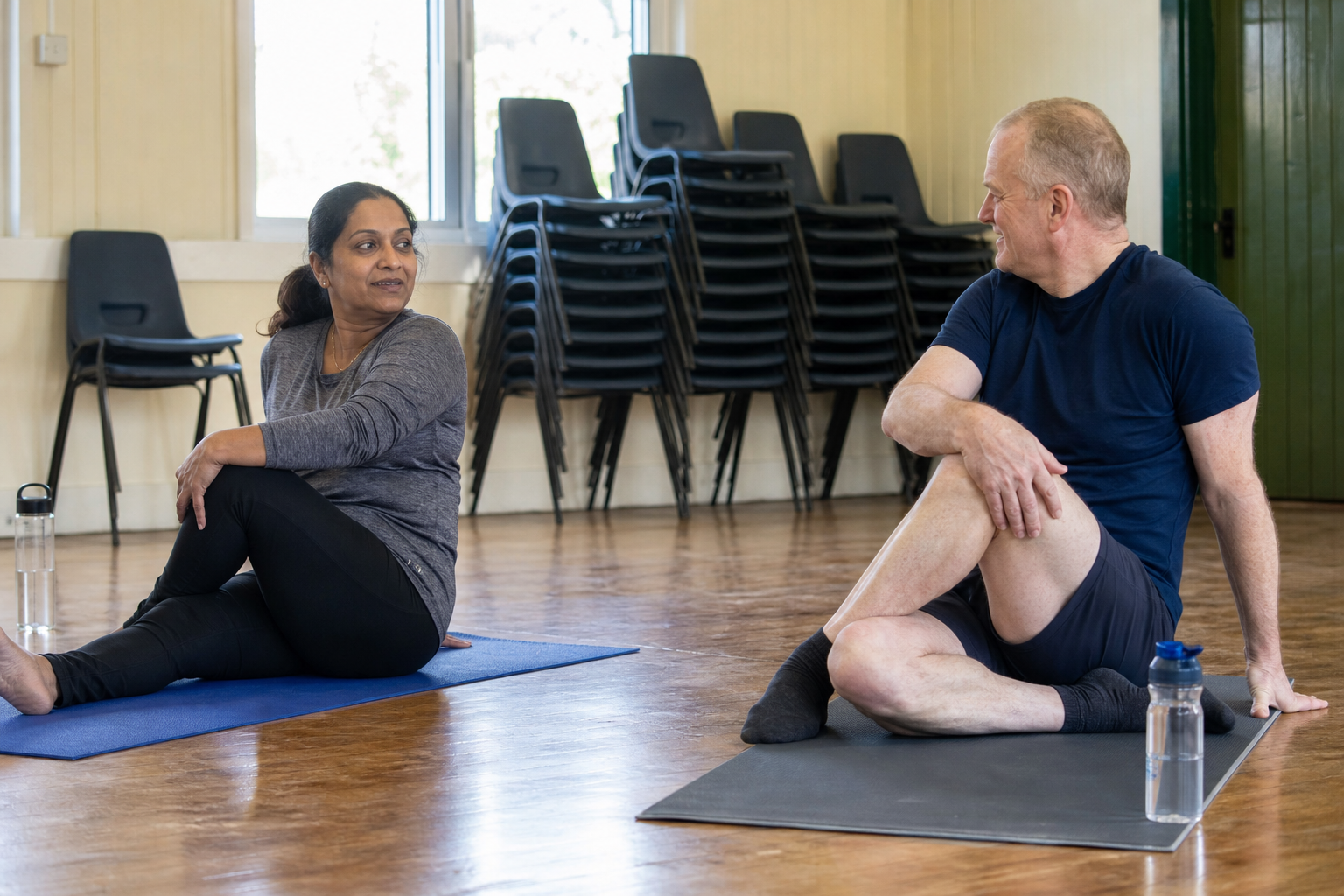
This routine replaces the crystal, colour and candle lists in the old article with something the body can feel. It uses slow breathing, a gentle movement and a minute of attention for each of the seven areas, on a mat or a chair, in a hall or a kitchen. Nothing in it opens or clears anything; what it does is give the nervous system fifteen minutes of slow breath, mild stretch and focused attention, which is the part of yoga and meditation that research supports. Stop any movement that hurts, and skip inversions or deep backbends if you have blood pressure, neck or back problems.
| Minutes | Area | Breath and movement | Attention |
|---|---|---|---|
| 0 to 2 | Arrival | Sit or stand; six slow breaths, exhale longer than inhale | Feet on the floor; weight through the heels |
| 2 to 4 | Root | Standing, sway side to side; slow knee bends | The pelvic floor and the ground |
| 4 to 6 | Sacral | Hip circles, both directions; gentle cat and cow on all fours | The lower belly rising on each inhale |
| 6 to 8 | Solar plexus | Seated twist each way; hands on the upper belly | The belly softening under the hands |
| 8 to 10 | Heart | Hands behind, open the chest; then hug the shoulders | The chest widening; any tightness there |
| 10 to 12 | Throat | Slow neck rolls; hum on three long exhales | The vibration of the hum in the throat |
| 12 to 14 | Third eye and crown | Sit still; eyes closed; breath through the nose | The space between the brows, then the top of the head |
| 14 to 15 | Close | Three ordinary breaths; open the eyes | The whole body at once; one word for how you feel |
- 1. BreatheExhale longer than you inhale, about four counts in and six out, for the whole routine.
- 2. MoveOne gentle movement per area, inside a comfortable range, never into pain.
- 3. AttendRest attention on the area for a minute; when it wanders, bring it back without comment.
- 4. NoteFinish with one word for how you feel and, if useful, which area held the most tension.
What research supports
No study has measured a chakra, because there is nothing to measure. What has been studied is the practice built around the map. Yoga that combines postures, breathing and attention has moderate evidence for reducing stress and low-back pain and for improving flexibility and sleep, and some evidence for anxiety and mood; the United States agency NCCIH summarises the trials in its guide to yoga and notes that it is generally safe when taught by a qualified instructor. Meditation and mindfulness have similar evidence for stress and anxiety, with results comparable to other active approaches, according to the same agency’s review of meditation. Slow breathing with a long exhale, the core of the routine above, reliably lowers heart rate and reported stress in the short term. Those are the benefits a chakra routine can fairly claim. They are worth having, and they do not depend on whether the map is true.
| Claim | Evidence | Honest wording |
|---|---|---|
| Yoga reduces stress | Moderate; many trials | Regular practice is likely to help |
| Slow breathing calms the body | Strong for short-term effects | Works within minutes; effect fades without repetition |
| Meditation helps anxiety and mood | Moderate; similar to other active approaches | Helpful for many; not a treatment on its own |
| Chakra work balances energy | None; no energy has been detected | A framework for attention, not a measurable effect |
| Crystals or colours open a chakra | None | Enjoy them if you like; they do nothing measurable |
| Blocked chakras cause disease | None; contradicted by medicine | Symptoms need a doctor |
Health claims to leave behind
The old article said that unbalanced chakras cause problems in the mind and body and that a Vogel crystal restores them. Both claims should go. Chakras do not cause disease, because they are a map of attention, not a physical system; illnesses have causes that medicine can name and, often, treat. The danger in the claim is not that it is untrue but that it delays care. A tight chest read as a heart chakra problem can be anxiety, reflux or a cardiac symptom, and only a clinician can tell which. Persistent symptoms, including fatigue, pain, digestive trouble, low mood and anything sudden or severe, belong with a family doctor or walk-in clinic. Anyone who offers to diagnose illness from your chakras or aura, or to clear a block for a fee, is a reason to leave and, if money changed hands, to report to the Canadian Anti-Fraud Centre. The companion article Balancing the Throat Chakra applies the same standard to one chakra in detail, and Understanding Auras does the same for the aura.
- Any claim that a chakra causes, predicts or explains an illness
- Crystals, colours or foods sold as the fix for a specific chakra
- Practitioners who diagnose from your energy and charge to clear it
- Advice to stop medication or delay a test until the energy is balanced
- Reading a chest, throat or stomach symptom as spiritual rather than medical
Key takeaways
- The seven-chakra map comes from medieval tantric texts; the rainbow colours and crystal pairings are twentieth-century additions.
- Chakras are a map for attention, not organs; blocked usually points to an ordinary state that can be named and addressed directly.
- The fifteen-minute routine is slow breathing, one gentle movement and a minute of attention per area, on a mat or a chair.
- Research supports yoga, meditation and slow breathing for stress, mood and flexibility; it has nothing to say about energy.
- Chakras do not cause disease; persistent or sudden symptoms belong with a doctor, and practitioners who diagnose from energy are a reason to leave.
Related reading
- Balancing the Throat Chakra
- Understanding Auras
- Reaching a Higher Vibration
- Create the Life That You Want by Using Kundalini Yoga
- Steps to Zen and Related Inner Peace
Frequently asked questions
1. What are chakras, in plain terms?
Points along the midline of the body, from the base of the spine to the top of the head, that meditation and yoga traditions use to organise attention. Each has a theme, such as safety, love or speech. They are a contemplative map rather than physical structures, and the language of energy around them is interpretive rather than factual.
2. Where does the seven-chakra system come from?
From tantric texts of Hinduism and Buddhism written from about the tenth century onward. Those texts list different numbers of centres; the set of seven became standard through a sixteenth-century text that reached English readers in 1919. The rainbow colours and the pairing with glands, crystals and foods are Western additions from the twentieth century.
3. Are chakras real?
As a map for attention, yes, in the sense that people have used it for a thousand years and it structures a practice. As physical or energetic organs, no; no instrument has detected one, and anatomy finds nothing at the locations. The practice can be worthwhile without the map being literally true, in the same way a story can be useful without being history.
4. What does it mean when a chakra is blocked?
It is a way of naming an ordinary state. A blocked throat chakra describes not saying what you mean; a closed heart chakra describes grief or guardedness; a weak solar plexus describes low confidence. The useful step is to translate the phrase into the state and respond to that directly, with a conversation, time, support or, if it persists, a doctor.
5. How do I keep my chakras open?
If the question means how to keep a regular practice of attention and movement through the body, the answer is a short daily routine: slow breathing, one gentle movement and a minute of attention for each of the seven areas, about fifteen minutes. Nothing physically opens or closes; what you are keeping is the habit.
6. What is in the fifteen-minute routine?
Two minutes of arrival breathing, then two minutes each for the root, sacral, solar plexus, heart and throat areas with a gentle movement and focused attention, two minutes of stillness for the third eye and crown, and a one-minute close. Exhale longer than you inhale throughout. It works on a mat, a chair or a community hall floor.
7. Do I need to do the areas in order?
No. Bottom to top is the traditional sequence and gives the routine a shape, but the benefit comes from breathing, moving and attending, not from the order. If one area holds tension, spend longer there. People with limited time can do the arrival breathing plus one area and still get the calming effect.
8. Can chakra work replace yoga or meditation?
It is a form of them. The routine here is a short yoga and meditation session organised by the chakra map. Research on those practices, rather than on chakras, is what supports it: moderate evidence for stress, sleep, flexibility and low-back pain, and some for anxiety and mood. A class with a qualified teacher adds correction and progression.
9. Do crystals, colours or foods help a specific chakra?
There is no evidence that they do anything measurable. Wearing a colour or keeping a stone on a desk can be a pleasant reminder to practise, which has some value. Buying crystals as a treatment for a state such as low confidence or grief spends money on the wrong thing; the state itself needs attention.
10. Can a blocked chakra cause illness?
No. Chakras are a map of attention and cannot cause disease. The claim matters because it delays care: a tight chest can be anxiety, reflux or a cardiac symptom, and only a clinician can tell which. Persistent fatigue, pain, digestive trouble or low mood, and anything sudden or severe, belong with a family doctor.
11. Is chakra breathing safe?
Slow breathing with a long exhale is safe for almost everyone and lowers heart rate within minutes. Avoid forceful or very rapid breathing techniques, which can cause dizziness and are not needed here. Anyone with a heart or lung condition, or who is pregnant, should keep the breathing gentle and check with a doctor about new exercise.
12. Which movements should I skip?
Anything that hurts, and any inversion or deep backbend if you have high blood pressure, glaucoma, or neck or back problems. The routine uses small, comfortable movements on purpose. A chair version, with the standing sway replaced by a seated rock, works for anyone with balance concerns.
13. How is a chakra reading different from a medical check?
A chakra reading is a conversation in a framework, usually about how someone feels in seven areas of life. It cannot detect illness. A reader who tells you a chakra shows a physical problem is guessing, and one who offers to clear it for a fee is a reason to leave. Report paid energy clearing to the Canadian Anti-Fraud Centre.
14. What is kundalini, and is it related?
In tantric tradition, kundalini is described as a coiled energy at the base of the spine that rises through the chakras in advanced practice. Modern kundalini yoga classes combine breathing, chanting and movement. Treat the energy as a framework; the exercises are ordinary yoga. Intense breathing practices can be unsettling, so start with a gentle class.
15. How often should I do the routine?
Daily if possible, because the calming effect of slow breathing fades within hours and returns with repetition. Fifteen minutes most days does more than an hour once a week. Pair it with a fixed cue, such as after the morning coffee or before dinner, and keep a one-word note each time so you can see over a month whether it helps.
16. Can children or older adults do it?
Yes, with movements scaled to what is comfortable. Children tend to enjoy the humming and the animal-style movements. Older adults may prefer the chair version. The breathing is the part that carries the benefit, and it needs no flexibility at all.
17. Does the colour of a chakra matter?
Only as a memory aid. The rainbow sequence was introduced in the 1970s and is not part of the older texts, which use different and inconsistent colours. If red at the base and violet at the crown help you remember the order, use them; if not, nothing is lost.
18. What should I do if a practice brings up strong emotion?
Attention on the chest or belly sometimes surfaces grief or fear that has been held down, and a wave of feeling during a routine is common and usually passes within minutes. Slow the breath and let it move through. If strong emotion, panic or intrusive memories keep returning, stop the routine and talk to a doctor or counsellor; anyone in crisis in Canada can call or text 9-8-8.
Evidence note: Chakras are described here as a contemplative map from medieval tantric texts, with the seven-colour scheme and crystal pairings as twentieth-century additions; no energy centre has been detected and none causes illness. The evidence on yoga, meditation and slow breathing is summarised from the United States agency NCCIH, which reports moderate benefit for stress and related outcomes. Persistent or sudden symptoms belong with a doctor, and anyone in crisis in Canada can call or text 9-8-8.
The suggestion to use colors and crystals to balance chakras is fascinating. While it may not be universally accepted in the scientific community, it seems like a harmless way to promote personal well-being and mindfulness.
Engaging in practices like meditation, yoga, and positive affirmations is beneficial regardless of one’s belief in chakras. These methods have proven to enhance mental and emotional health and promote a balanced lifestyle.
The article provides a comprehensive overview of chakras and their significance. However, the scientific validation of chakras remains a topic of debate. It’s interesting to see how ancient beliefs are intertwined with modern practices like yoga and meditation.
The historical context provided about chakras being rooted in Hindu religion and ancient texts adds a layer of credibility to the concept. Although empirical evidence may be lacking, the cultural and historical significance is undeniable.
The emphasis on forgiveness and thankfulness as methods to balance chakras aligns well with psychological approaches to mental health. It’s a holistic way to address emotional and spiritual well-being, even if one is skeptical about the existence of chakras.