

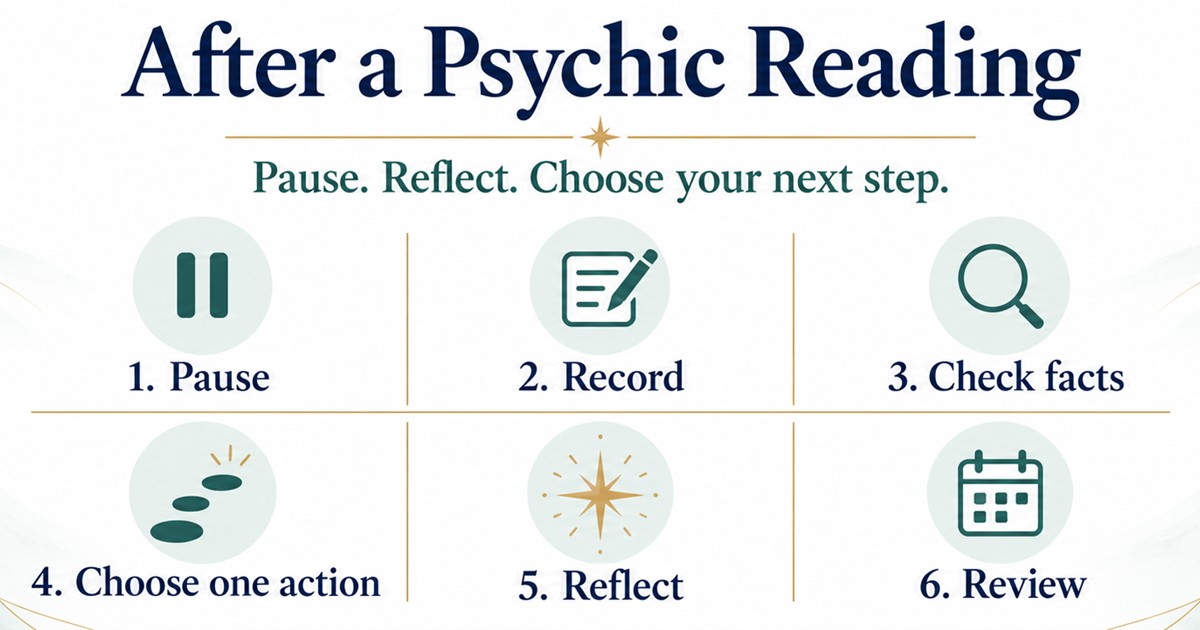
A reading can leave you encouraged, thoughtful or unsure what to do with everything you heard. Give the session a little room before deciding what belongs in your life. You can welcome spiritual insight without accepting every statement or making a major decision on the spot.
The useful question is “What do I want to take from this?” Your choices remain yours. A prediction that does not happen is not evidence that you failed to believe, raise your energy or work hard enough.
1. Pause and return to your day
Before booking again or sending an emotional message, take an ordinary break. Notice your surroundings, get comfortable and attend to what your day actually requires. There is no compulsory waiting period or ritual. If something urgent needs real-world attention, deal with that directly rather than waiting for a sign.
2. Record what was actually said
Write a short account while you remember it. Keep the reader’s words separate from your interpretation and from information you later discover. Include unclear statements, misses and things you supplied during the conversation, alongside anything that felt meaningful.
If you have an authorized recording, check who can access it and how long you want to keep it. Do not share other people’s private details. Our phone-reading privacy guide covers accounts, recordings and stored notes.
3. Separate insight, uncertainty and facts
Ask three questions: What resonated with my experience? What remains unverified? What practical information would I need before acting? A comment about a partner’s feelings, a future job or your health is not established merely because it felt specific.
You do not need to force a match when a statement does not fit. Keeping an open mind includes considering that an interpretation may be mistaken. For health symptoms, legal questions or financial commitments, seek the relevant qualified help and records.
4. Choose one modest action
Turn a useful theme into something within your control. If the reading brought up career confidence, you might review a job description or update one section of your résumé. A relationship theme might become a respectful question, provided it is safe and welcome to ask.
For example: “I heard a theme of change. I know I have been curious about another role. This week I will compare the qualifications for one opening.” The action makes sense without relying on a forecast that an employer will choose you.
You can also decide to take no action. Illness, another person’s choices and circumstances outside your control are not problems you can fix simply by changing your mindset.
5. Keep a spiritual practice that feels useful
A quiet intention, a card image, prayer or a short reflection can help you return to the question that matters. Our intuitive tarot exercises offer ways to notice imagery without turning every impression into a conclusion.
If you enjoy visualization, picture the next manageable step, such as preparing for a conversation, rather than treating an imagined outcome as a guarantee. An affirmation can be equally practical: “I can ask for the information I need.” You do not have to repeat a statement you do not believe.
Keep attention exercises comfortable. Meditation is optional; NCCIH’s meditation guidance discusses both evidence and safety limits. You can choose an everyday activity instead if inward focus is uncomfortable.
6. Review before paying for another session
Write down a genuinely new question and check whether it needs another reading, a direct conversation or ordinary research. For clarification about what was included, ask the service about its follow-up policy and any charge before starting.
Repeatedly asking the same question until you feel reassured can make it harder to sit with uncertainty. You do not need a reading schedule to stay spiritually connected. Pause if the cost, urgency or search for certainty is becoming difficult to manage. The Canadian reading-budget guide can help you set a firm optional-spending limit.
Free after-reading action card
Use these five lines in your head or a private note:
- The statement: What did I actually hear?
- My response: What feeling or personal association came up?
- The evidence: What do I know, and what remains uncertain?
- My next step: What small action would still make sense if the prediction were wrong?
- My review point: When would it be useful to look back, and what would count as useful progress?
Include an option to do nothing for now. A review is about your experience and choices, not searching only for signs that make a reading seem correct.
Let reflection stay flexible
Personal and spiritual growth need not follow a straight line. You may keep an insight, change your interpretation later or decide that a session was not helpful. Appreciation for a reader’s time does not require praise, a tip, a positive review or another purchase.
If you are dissatisfied, keep the relevant messages and receipts and check the service’s written complaint process. Our guide to what to do after an unsatisfying reading offers a separate route for concerns about the service. A reading is most useful when there is room for your judgment, your boundaries and the life you are actually living.
Frequently asked questions
1. What should I do immediately after a psychic reading?
Take an ordinary break, notice how you feel and make a brief record of what was said before deciding on any action.
2. Should I write down everything?
You can keep a short account rather than a transcript. Include uncertainties and misses as well as meaningful statements.
3. Should I record the session?
Only when recording is permitted and everyone involved has agreed. Check the service’s privacy and storage terms.
4. What if a prediction frightens me?
Do not treat it as an established event or pay for a remedy under pressure. Seek appropriate support for real concerns.
5. Must I act on every suggestion?
No. Consider your circumstances, reliable information and your own boundaries. Taking no action can be a valid choice.
6. How do I turn an insight into action?
Choose one small step within your control that would still be sensible if the prediction were wrong.
7. Does a failed prediction mean I blocked it?
No. A reading’s failure does not establish that your beliefs, energy or effort caused the outcome.
8. Can I ask for clarification afterward?
Ask about the service’s follow-up policy and any charge first. You are not obliged to purchase a second appointment.
9. How soon should I book another reading?
There is no required timetable. Check whether you have a new question, a clear purpose and room in your budget.
10. What if I keep asking the same question?
Consider pausing the readings and talking with someone supportive. Repetition may not supply the certainty you want.
11. Can I use tarot or journaling between sessions?
Yes, if they feel useful and comfortable. Keep impressions separate from facts and avoid making another person’s choices through a card.
12. Will visualization make the prediction happen?
Imagining an outcome does not guarantee it. You may prefer to picture a practical step you can actually take.
13. Do I have to feel grateful for an upsetting session?
No. You can be courteous while giving honest feedback or deciding that the service did not help you.
14. Can a reading guide medical or financial decisions?
Use qualified advice and reliable records for consequential decisions. A reading does not establish a diagnosis or an investment outcome.
15. What if I want to leave the reading unresolved?
You can. Spiritual reflection does not require an immediate interpretation, a purchase or a major change.